GoHighLevel WhatsApp Pricing Changes (Oct 2026)
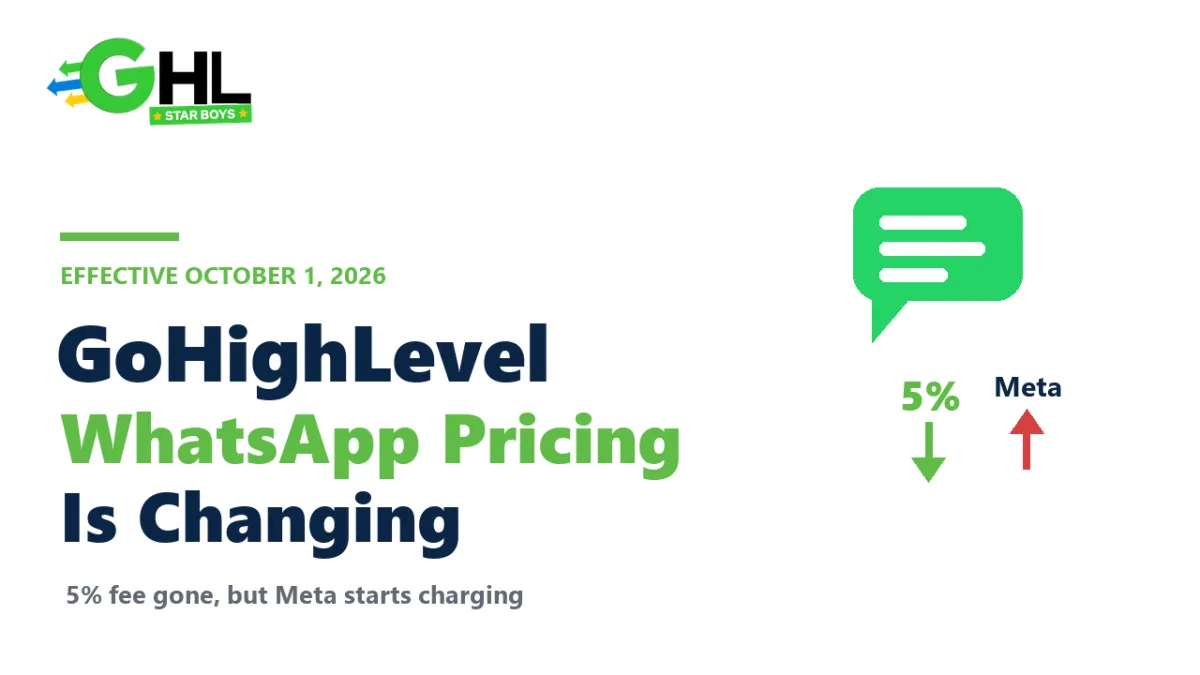
What is changing with GoHighLevel WhatsApp pricing on October 1, 2026? Two things at once. GoHighLevel is removing its 5% processing fee, so you pay Meta's published rate to the cent, and Meta is starting to charge for service and utility messages sent inside the 24-hour customer service window, with the first 1,000 service messages per phone number free each month. Whether your bill goes up or down depends on how conversational your WhatsApp usage is.
This is one of those changes that is easy to miss until your invoice looks different. If your agency uses WhatsApp inside GoHighLevel at all, especially with automations or Conversation AI replying to customers, it is worth understanding before the first of October rather than after. Here is exactly what changes, who it helps, who it costs, and what to do about it.
What is changing on October 1, 2026?
Per the official HighLevel changelog, two separate changes land on the same day. First, GoHighLevel drops the 5% markup it added on top of Meta's WhatsApp rates, so from October 1 you pay Meta's exact published price. Second, and this part is Meta's doing rather than GoHighLevel's, Meta begins charging for message types that used to be free inside the customer service window. The two changes pull in opposite directions, which is why the net effect is different for every account.
The 5% fee removal: the good news
Until now, GoHighLevel added a 5% processing fee on every WhatsApp message on top of what Meta charged. From October 1 that markup is gone. You pay Meta's rate directly, and the numbers match to the cent. On its own, this is a straight saving on every message you send, and it makes your WhatsApp costs easier to predict and to rebill to clients accurately.
Meta's new service and utility charges: the catch
The offsetting change comes from Meta. Starting October 1, Meta charges for service messages, which are the free-form replies you send inside an open 24-hour customer service window. Crucially, that includes more than just manual replies. A service message is any free-form reply sent in that window, which covers:
- Manual replies your team sends from the Inbox
- Automated replies sent by your workflows
- Replies sent by Conversation AI
Meta gives each phone number the first 1,000 service messages free, after which they are billed. On top of that, utility templates and service messages sent inside the service window are no longer free. As of Meta's September confirmation, a service message costs the same as a utility or authentication template sent to the same country, so pricing now depends heavily on where your contacts are. Full mechanics are in the HighLevel WhatsApp pricing and billing guide.
Before and after October 1
Here is the change at a glance.
| Item | Before Oct 1, 2026 | From Oct 1, 2026 |
|---|---|---|
| GoHighLevel 5% fee | Added on every message | Removed, you pay Meta's exact rate |
| Service messages (in 24h window) | Free | Charged after the first 1,000 per number |
| Utility templates in window | Free | Charged |
| Automations and AI replies | Free inside the window | Count as billable service messages |
Will your WhatsApp costs go up or down?
It depends entirely on volume and how you use WhatsApp. If you send a modest number of messages and stay under the 1,000 free service messages per number, the removal of the 5% fee likely leaves you slightly better off. If you run high-volume, conversational WhatsApp, with workflows and Conversation AI firing lots of replies inside the service window, you will probably pay more overall, because those automated replies now count as billable service messages once you pass the free allowance. The businesses most affected are the ones leaning hard on AI-driven conversations, since every AI reply in the window is now a metered message.
What agencies should do before October 1
A little preparation avoids a surprise invoice:
- Audit your WhatsApp volume. Look at how many service messages each number sends in a month, and whether you are near or past the 1,000 free threshold.
- Review your automations. Workflows and Conversation AI that reply inside the service window now cost money, so tighten any that fire more than they need to. This is the same discipline we cover in avoiding costly automation mistakes.
- Set up rebilling with a markup. If you resell GoHighLevel, pass WhatsApp usage through to clients with your own margin so the new charges do not eat into yours. This is exactly what GoHighLevel SaaS Mode is built for.
- Mind contact geography. Since a message now costs the same as a utility or auth template to that country, where your contacts are located matters more than before.
If untangling WhatsApp billing and automations is not how you want to spend the week, a GoHighLevel expert can audit your setup and get the rebilling right before the change hits.
Frequently asked questions
Is GoHighLevel removing its WhatsApp fee?
Yes. From October 1, 2026, GoHighLevel removes the 5% processing fee it added on top of Meta's WhatsApp rates. From that date you pay Meta's published rate directly, with no GoHighLevel markup, so your per-message cost from GoHighLevel drops.
What is a WhatsApp service message?
A service message is any free-form reply sent inside an open 24-hour customer service window. That includes manual replies from the Inbox, automated workflow replies, and Conversation AI replies. From October 1, 2026, Meta charges for these after the first 1,000 per phone number.
Will my GoHighLevel WhatsApp costs go up?
It depends on volume. Low-volume senders who stay under the 1,000 free service messages may save money from the removed 5% fee. High-volume, automation-heavy senders will likely pay more, because workflow and AI replies inside the service window now count as billable messages.
How can agencies avoid paying more for WhatsApp?
Audit your message volume, tighten automations that reply unnecessarily inside the service window, and set up rebilling with a markup so clients cover the usage. Watching contact geography helps too, since a message now costs the same as a utility template to that country.
The bottom line
October 1 brings a genuine saving from GoHighLevel dropping its 5% fee, wrapped around a real new cost from Meta charging for service and utility messages inside the window. For light WhatsApp users it is a small win. For automation-heavy agencies it is a reason to review usage and rebilling now, not after the invoice arrives. Either way, understanding the change before it lands is what keeps it from becoming a surprise.
Want your WhatsApp billing and automations sorted before October 1?
GHLStarboys' GoHighLevel experts can audit your setup, tighten the automations, and get rebilling right so the change works in your favor. Book a free growth call to get started.