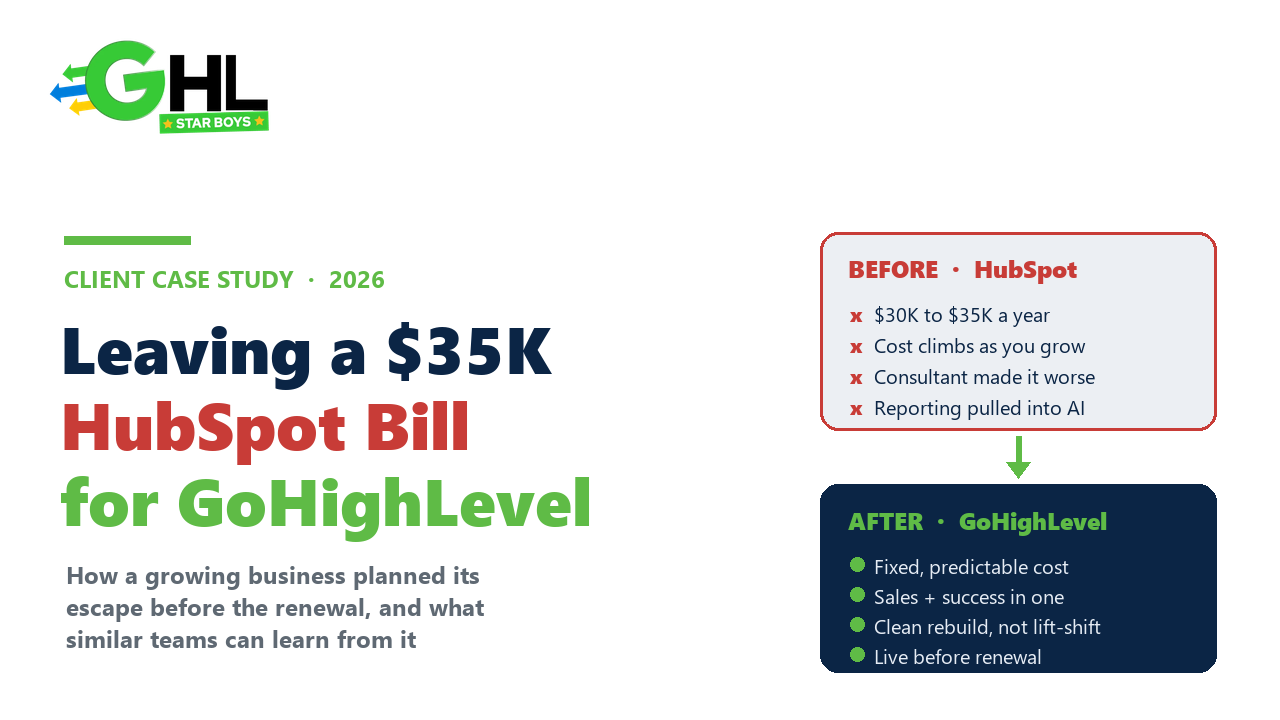
Case Study: Leaving a $35K HubSpot Bill for GoHighLevel
This is a real story from a recent call, shared with the client's details removed. A growing business reached out to us with a problem that will sound familiar to a lot of scaling companies: they were paying somewhere between $30,000 and $35,000 a year for HubSpot, a renewal was coming up, and they were not convinced they were getting their money's worth. What they described on that call is almost a checklist of why mid-sized businesses start looking for a HubSpot alternative. Here is their situation, the plan we built with them, and what any business sitting on a bloated, expensive CRM can take from it.
The situation: a growing business stuck with an expensive CRM
The company is not an agency. It is a scaling business with an in-house sales team and a customer success team, a few thousand accounts in the system and roughly 200 to 250 active customers. They do a lot of outbound advertising, so marketing and CRM sit close together in how they work. HubSpot had been their system for a while, and on the sales side it mostly did the job. The problem was everything around it: the cost, the data, the parts of the business HubSpot was not serving, and a bad experience with outside help. The CEO had been to an event where person after person told him the same thing: go look at GoHighLevel.
The breaking points
No single thing pushed them to look elsewhere. It was five things stacking up, and each one is common.
1. Cost that climbs as you grow
Their own estimate was 30 to 35 thousand dollars a year, maybe more, and like a lot of growing businesses they had learned that HubSpot gets more expensive precisely as you succeed. More contacts, more seats, more of the features you actually need, and the bill keeps climbing. For a business trying to scale, a cost that rises with every bit of growth is a tax on exactly the thing they are working toward.
2. A consultant who made it worse
A few months earlier they had paid a HubSpot consultant to help. In their own words, it was a total waste of money, half a job done, and it arguably left the setup more confusing than before. Anyone who has hired the wrong help knows the feeling: you pay to fix a problem and end up with the original problem plus a mess to untangle.
3. Years of messy data
When their operations lead joined two years earlier, the CRM was not in a good state, with a lot of poor-quality data built up over time. They had been doing their best to rationalize it and make HubSpot more usable for the teams, but cleaning a cluttered CRM while still running on it is slow, thankless work.
4. Half the business was underserved
HubSpot worked reasonably for sales, but the customer success team did not get the value they should have. A big reason: the customer success tooling is a separate product you pay extra for, which they were not able to buy. So the full lifecycle, from lead through to active customer and eventually to a customer leaving, was not something the system handled well end to end.
5. They had already routed around it
The clearest signal of all: they had moved almost all of their HubSpot reporting out of HubSpot and into an AI tool, because it was more configurable and gave them better data. When a team is paying tens of thousands a year for a CRM but pulling its reporting out of that CRM to get usable answers, the platform is no longer earning its price.
Why they looked at GoHighLevel
Two things drew them in. First, cost: GoHighLevel is priced as a predictable, largely fixed subscription rather than a bill that scales up with every contact and campaign, which for a growing business is a fundamentally different model. Second, marketing: because they run a lot of outbound advertising, having funnels, email, SMS and campaigns in the same system as the CRM was genuinely exciting to them. The one hesitation was a fair one, and we hear it constantly: GoHighLevel is marketed heavily to agencies, and they are not an agency. The honest answer is that the agency focus is a marketing history, not a product limit. HighLevel has been broadening toward serving businesses directly, and the sales, pipeline and reporting a non-agency team needs are all there. We unpack the full head-to-head in our GoHighLevel vs HubSpot comparison.
HubSpot vs GoHighLevel for a growing business
Here is the comparison the way it actually mattered to this company.
| HubSpot | GoHighLevel | |
|---|---|---|
| Pricing model | Climbs with contacts, seats and campaigns | Largely fixed monthly subscription |
| Cost in this case | $30,000 to $35,000+ a year | A fraction of that, predictable |
| Marketing tools | Higher tiers or add-ons | Funnels, email, SMS and ads built in |
| Full lifecycle (sales plus success) | Customer success is a separate paid product | Sales and post-sale in one system |
| Setup and support | Expensive consultants | Done-for-you GoHighLevel experts |
| Best fit | Enterprises with the budget | Growing businesses wanting all-in-one at a fixed cost |
The migration plan we built
The deadline made the plan. Their HubSpot renewal, and another $35,000, was due at the start of January, so the goal was to get the most important parts of the business running on GoHighLevel before that date so they would not have to renew. A few principles shaped it.
Do not lift and shift. They were clear they did not want to simply dump HubSpot's data into a new tool and carry on, because many of their frustrations would come along for the ride. A migration is the rare chance to rebuild the lifecycle properly: lead capture, sales pipeline, onboarding, customer success and win-back, designed around how the business actually runs. Starting clean, rather than inheriting a cluttered build, is almost always what an experienced migrator recommends. Our guide to migrating to GoHighLevel walks through that process.
Match the resource to the deadline. Their first instinct was to test the waters with a small block of hours and maybe a light retainer. For a migration with a hard January cutoff and a few thousand records, that was not going to be enough. A migration of this size, done to a deadline, needs a dedicated expert working on it consistently, not an occasional few hours. We talked through the real trade-off between a small pay-as-you-go block and a full-time dedicated resource, which is exactly the kind of math we lay out in what a GoHighLevel expert costs.
Fix what HubSpot could not. The migration was also the moment to finally give the customer success team a system that serves them, and to build the clean reporting they had been forced to pull out of HubSpot. Getting that right is less about the platform and more about the build, which is where ongoing GoHighLevel automation support comes in.
What similar businesses can learn from this
You do not need to be this exact company to see yourself in it. The lessons are general.
- Audit the bill before the renewal, not after. If your CRM cost rises every year as you grow, price out a fixed-cost alternative well before you are cornered into renewing.
- A cheap tool with the wrong help is still expensive. The worst spend here was not the software, it was a consultant who left things worse. Vet who builds your system as carefully as the system itself.
- Do not migrate your mess. Moving platforms is the best chance you will get to rebuild the full customer lifecycle properly. Take it.
- If you are routing around your CRM, that is your answer. Pulling reporting or whole workflows out of the tool you pay for is a sign the tool no longer fits.
- Match the help to the deadline. A real migration on a timeline needs dedicated hands, not a few spare hours here and there.
If the cost side is what is nagging you, our 2026 GoHighLevel pricing guide and our breakdown of whether GoHighLevel is worth it are the two places to start.
Work with the team behind this migration
Migrations like this are a large part of what we do. GHLStarboys is an official HighLevel 2026 Marketplace Award winner with 350+ vetted experts serving 1,200+ agencies and businesses, and we have handled many HubSpot to GoHighLevel moves, from cleaning years of messy data to rebuilding the whole lifecycle before a renewal deadline. If you are staring at a CRM bill that keeps climbing, or a renewal you are not sure you want to pay, book a free growth call and we will map your migration, tell you honestly whether GoHighLevel fits, and show you what it would take to be running before your renewal date.
Frequently asked questions
Why do businesses migrate from HubSpot to GoHighLevel?
The main reason is cost. HubSpot pricing climbs with contacts, seats and campaigns as a business grows, while GoHighLevel is a largely fixed subscription. Businesses also move to get marketing and CRM in one system, and to escape per-product add-ons like separate customer success tooling.
Does GoHighLevel work for businesses that are not agencies?
Yes. GoHighLevel was marketed heavily to agencies, but that is marketing history, not a product limit. The sales pipelines, reporting, automations and marketing tools a non-agency business needs are all there, and HighLevel has been broadening to serve businesses directly.
How long does a HubSpot to GoHighLevel migration take?
It depends on the size and how much you rebuild rather than copy. A few thousand records with a full lifecycle rebuild, done to a deadline, needs a dedicated expert working on it consistently rather than a few occasional hours. The cleanest results come from rebuilding properly, not lifting and shifting the old mess.
Should I move my HubSpot data over as-is?
Usually not. A migration is the best chance to rebuild your lead-to-customer lifecycle properly. Copying a cluttered setup across carries the same frustrations into the new tool. Most experienced migrators recommend starting clean and bringing across only what is useful.
Is GoHighLevel cheaper than HubSpot?
For most growing businesses, yes, and more predictably so. GoHighLevel is a largely fixed monthly cost, while HubSpot tends to rise with contacts, seats and add-on products. In this case the company was facing a $30,000 to $35,000 annual renewal, which GoHighLevel can replace at a fraction of the cost.
The bottom line
This company's story is not unusual, it is just honest. A CRM that got more expensive as they grew, a bad experience with outside help, messy data, a team that was underserved, and reporting they had already moved elsewhere. Put together, that is a business paying premium prices for a tool it had quietly outgrown. The fix was not just a cheaper platform, it was a clean rebuild of how the whole lifecycle runs, finished before the renewal clock ran out. If any of that sounds like your setup, our award-winning team can tell you plainly whether a move makes sense. Book a growth call and we will look at your numbers with you.